
PSCU APPROACH
How Does the PSCU Affect Soil Compaction?
The Puricare Air /Water /Soil Treatment Pathway
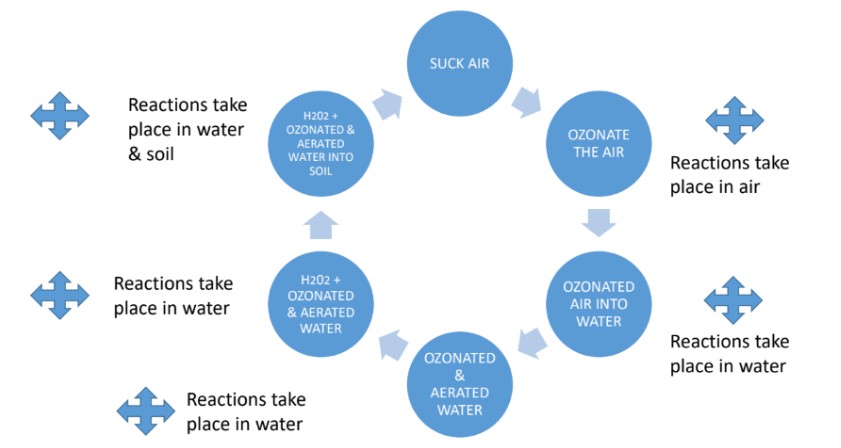
Does Oxygen in Irrigation Water Reduce Soil Compaction?
- Most irrigation systems add only slight aeration, with little to no effect on compaction.
- In distilled water, oxygen lasts up to 20 minutes — in normal or irrigation water, less than 10 minutes.
- Equilibrium is quickly restored, limiting long-term impact.
- Ozone (O₃) and hydroxyl radicals (OH), formed from ozone and H₂O₂, have half-lives of just seconds to a few minutes (3–12 min).
- Research shows up to 99% of ozone is lost within 1 second after entering the soil, penetrating only about 2 mm.
- Hydroxyl radicals behave similarly, reacting instantly.
- While these oxygen species can interact with soil microbes, their role in reducing compaction is minor — their lifespan is too short to drive major changes directly.

Air & Water Reactions
- Reactions take place in air, water, and soil
- Irrigation water contains chemicals, fertilizers, waste, sewage, CO₃, and HCO₃
- Oxygen and ozone in irrigation water have very short lifespans once in soil
- Therefore, oxygen plays only a minor direct role in soil changes

What Causes the Change?
The PSC Unit improves the quality of irrigation water primarily through oxidation effects and interactions in water, which influence soil chemistry:
- Reduces clay dispersion.
- Increases pore spaces in clay micro- and macro-structures.
- Improves aeration and stimulates soil/microbe/root interactions

Oxidation Effects
- Ozone increases hydraulic conductivity and reduces clay dispersion.
- Oxidation of organic matter releases cations and anions.
- pH decreases in treated water, dissolving minerals like Ca and Mg.
- Calcium replaces sodium on clay particles, improving soil structure.

How Does The PSCU Reduce Soil Compaction
- Reduced clay dispersion = reduced compaction.
- Better aeration = improved microbial activity and nutrient availability.
- Improves soil/root environment and reduces toxic by-products.

Soil Amendments
Common amendments to reduce compaction include:
- Gypsum (Calcium sulphate).
- Sulphuric acid or sulphur burners.
- These improve clay flocculation by replacing sodium with calcium.

Problems Compacted Soils Cause
- Compaction leads to the buildup of toxic by-products from microbial activity.
- It also drives denitrification, where nitrate (NO₃⁻) is converted to nitrogen gas (N₂) or nitrogen oxides, which escape into the atmosphere.
- In compacted soils, heavy metals are reduced to a lower oxidation state, making them more soluble and potentially toxic:
- Iron: Fe³⁺ → Fe²⁺
- Manganese: Mn⁴⁺ → Mn²⁺
- Copper: Cu³⁺ → Cu²⁺
- The PSCU system counters this by raising the oxidation state, making metals less soluble, less available, and easier to leach away safely.

Correct Your Soil. Boost Your Yields
Let’s Restore Your Soil for Healthier, Higher Yields